Financial Services
An important financial decision has been approved. Before execution, circumstances change.
Can it still be executed?
Independent execution validation
Every day, organisations approve decisions that will later be executed.
Most of the time, that is exactly what should happen.
But between approval and execution... things can change.
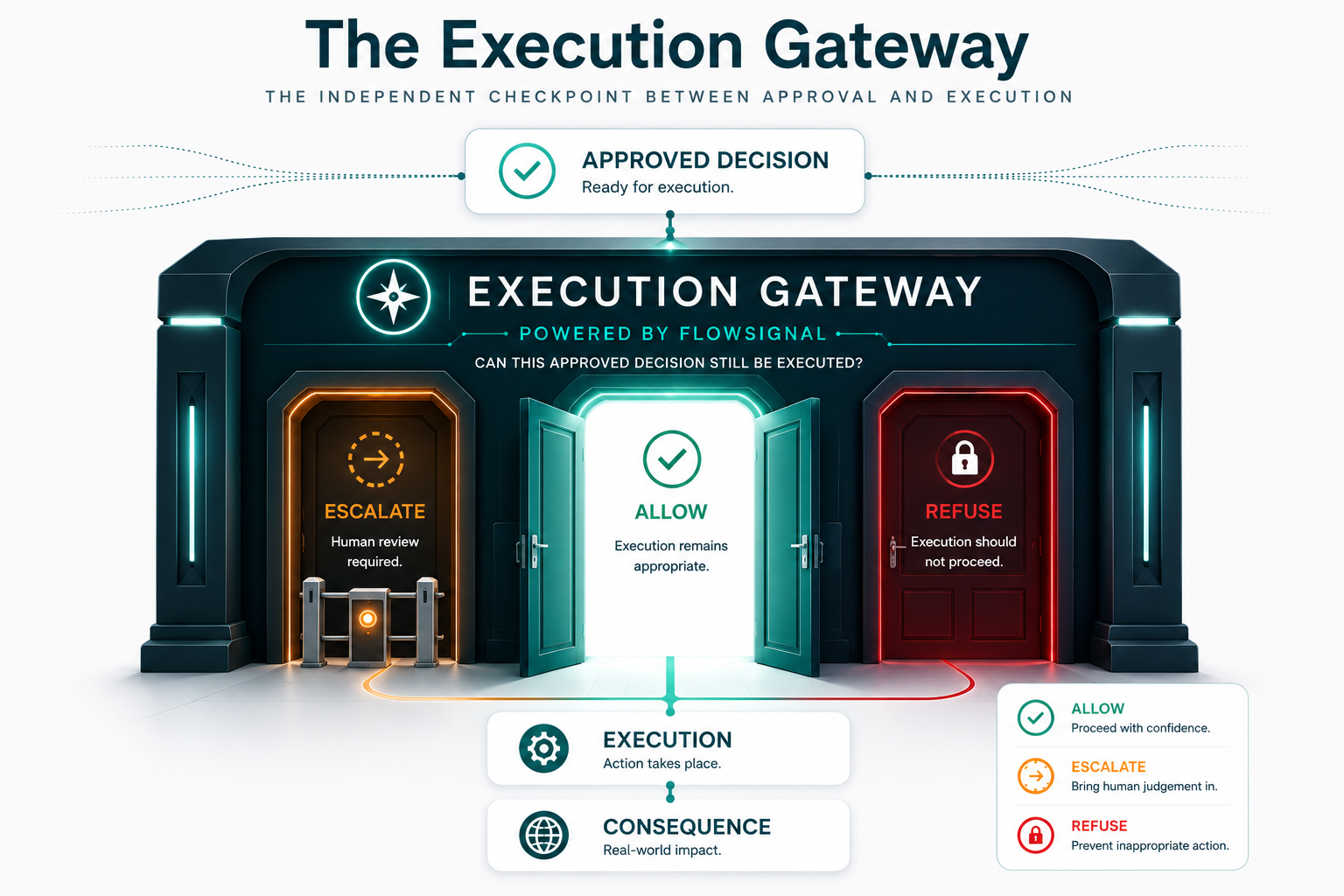
FlowSignal independently validates whether an approved decision can still be executed before action is taken.
The gap
A decision may be approved today. It may not be executed until tomorrow, next week, or when circumstances have already changed.
Universal problem
Different domains. Different consequences. The same execution challenge.
An important financial decision has been approved. Before execution, circumstances change.
Can it still be executed?
An important clinical decision has been approved. Before action begins, the patient's condition changes.
Can it still be executed?
An important public sector decision has been approved. Before execution, new information becomes available.
Can it still be executed?
An operational decision has been approved. Before execution, operating conditions change.
Can it still be executed?
A production decision has been approved. Before execution, a quality or safety issue is identified.
Can it still be executed?
An operational decision has been approved. Before execution, intelligence changes the situation.
Can it still be executed?
Existing systems
Governance, policies, approvals, risk management and workflow are all essential. They answer one important question.
Existing systems answer
FlowSignal answers
How it works
Every important decision passes through one final independent validation before execution.
Fit
FlowSignal is not designed to replace the systems you already trust. It adds one independent validation immediately before execution.
Why now?
Important actions can now happen faster, at greater scale, and with fewer natural pauses for people to notice when circumstances have changed.
FlowSignal restores independent validation at the point where it matters most.
Why independent?
The closer a decision gets to creating a real-world consequence, the more important independent validation becomes.
Makes an objective execution decision using your organisation's existing policies, authority and operational context.
Works alongside your existing governance, workflow and policy systems without replacing them.
Creates evidence explaining why execution was allowed, escalated or refused.
Before that happens, make sure it is still right to proceed.
FlowSignal
Execute with Authority. Defend with Evidence.