Execution Boundary Runtime Authority Service

Authority at the point of execution.

FlowSignal determines whether AI-influenced actions are authorised before they create real-world consequence.

  • Authority becomes binding
  • Control becomes real
  • Governance becomes enforceable

If you cannot resolve authority at execution, you are not controlling outcomes — you are explaining them after the fact.

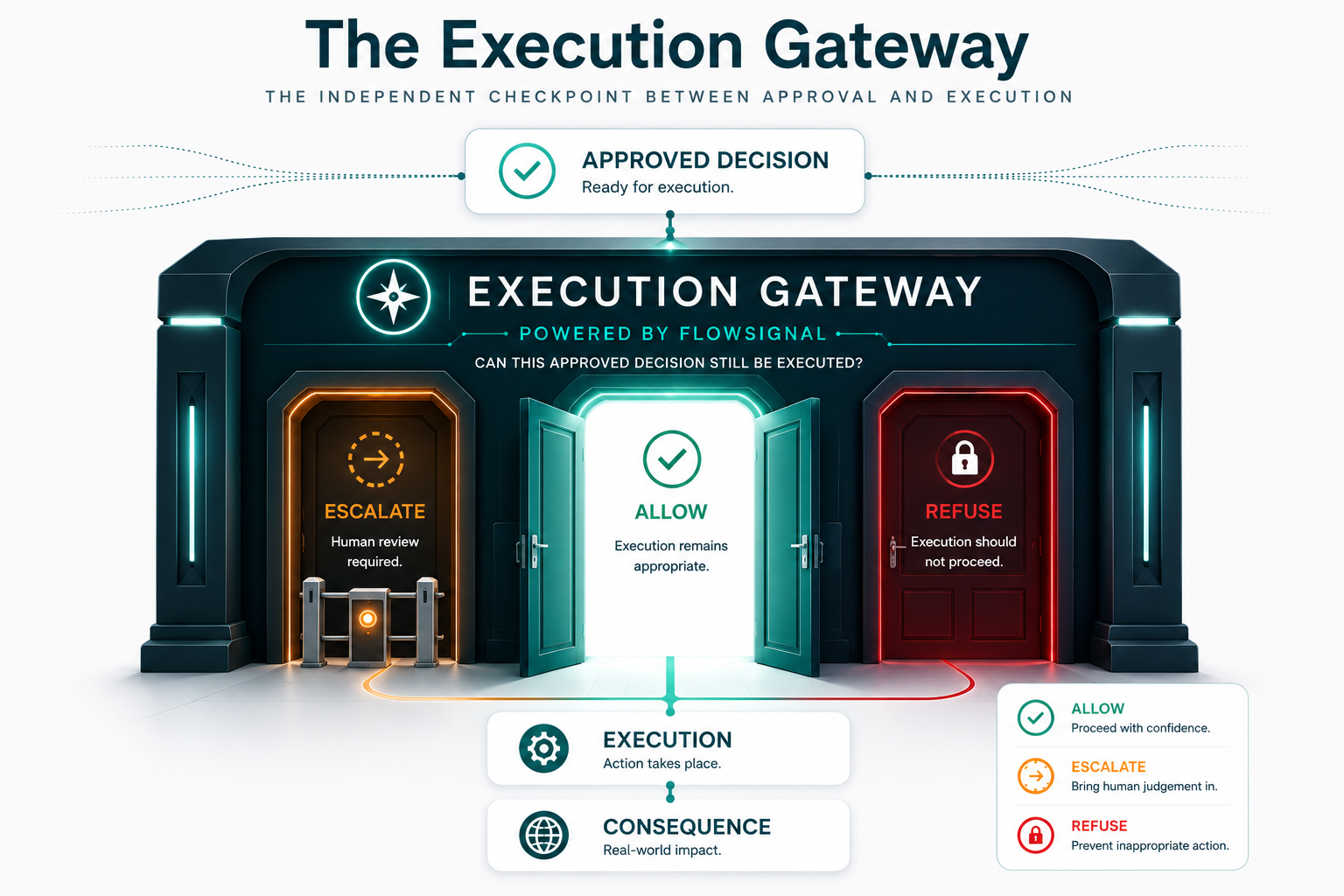
AI / Agents / Humans → Controlled at execution ALLOW • ESCALATE • REFUSE

How FlowSignal works

AI / Agent / Human Trigger
Recommendation, approval, threshold event, or automated instruction.
FlowSignal Execution Boundary
  • Mandate scope
  • Delegation chain
  • Evidence sufficiency
  • Override admissibility
Deterministic Output
ALLOW ESCALATE REFUSE
Execution System
Payments • Access • Records • Core operations
1control point before consequence
3deterministic outcomes
4core authority checks
24/7runtime enforcement posture

The Problem

Most governance stops before execution.

AI systems can recommend, approve, deny, trigger, and act. Most control frameworks focus on policy upstream and audit trails downstream. Very few verify whether authority still holds when the action is about to become real.

The missing question

Was this action authorised in the live conditions that existed when execution became binding?

Why The Execution Boundary Matters

Everywhere else is preparation, interpretation, or reconstruction.

Upstream

Decision formation

  • Models recommend
  • Policies define intent
  • Humans or systems prepare action

Execution Boundary

Authority resolves here

  • Authority becomes binding
  • Control becomes real
  • Governance becomes enforceable

Downstream

After consequence

  • Logs explain what happened
  • Audit reconstructs it later
  • Risk has already materialised

Category Clarification

FlowSignal is not another governance dashboard.

IAM

Answers: Who are you?

  • Authentication
  • Role assignment
  • Access rights

Policy & Governance

Answers: What should happen?

  • Frameworks and mandates
  • Controls and process
  • Oversight obligations

Runtime Authority

Answers: May this action execute now?

  • Admissibility at bind
  • Escalation when authority fails
  • Refusal before state change

Runtime Architecture

FlowSignal sits between decision and consequence.

FlowSignal operates at the final control point before an action commits. It does not replace identity, policy, or observability. It resolves whether execution may proceed.

Decision Formation

AI models • Agents • Orchestrators • Human approvals

FlowSignal Runtime Authority Layer

Mandate • Delegation • Evidence • Policy binding • Escalation

Execution Systems

Payment sent • Access granted • Record updated • Action committed

Runtime Flow

Authority resolved at the point of execution

Decisions don’t create outcomes. Execution does.

Decision AI / Agent / Human Decision
Execution Boundary FlowSignal Boundary
ALLOW ESCALATE REFUSE
Execution Execution System
Outcome Real-World Outcome

Product Logic

Authority is more than permission.

FlowSignal evaluates

  • Mandate scope
  • Delegated authority
  • Evidence sufficiency
  • Human oversight conditions
  • Jurisdiction and policy binding
  • Override admissibility

FlowSignal returns

ALLOW

Execution may proceed.

ESCALATE

Human intervention required.

REFUSE

No execution path.

Entry Offer

Authority Validation Sprint

Most organisations cannot prove authority at the moment of execution.

This sprint determines whether you can — before a regulator, board, or failure event does it for you.

  • Map where decisions actually bind
  • Define enforceable runtime authority
  • Pressure-test admissibility and failure paths
  • Design defensible evidence at execution

What you get

  • Decision surface map
  • Runtime authority specification
  • Admissibility matrix
  • Execution evidence model
Outcome

Authority becomes provable at execution.

No interpretation. Deterministic control.

Regulatory Alignment

Designed for the EU AI Act era.

EU AI Act

  • Article 9 — Risk management systems
  • Article 13 — Transparency and information provision
  • Article 14 — Human oversight

Operational Outco

Entry Offer

Authority Validation Sprint

A focused executive engagement to determine whether your organisation can prove authority at execution — or not.

  1. Decision surface mappingMap inputs, models, tools, overrides, and where consequence binds.
  2. Authority definitionDefine mandate, scope, jurisdiction, and escalation rules.
  3. Admissibility testingPressure-test edge cases, refusal paths, overrides, and out-of-scope actions.
  4. Evidence architectureDefine what must be sealed at decision time for defensible reconstruction.

Regulatory Alignment

Designed for the EU AI Act era.

EU AI Act

  • Article 9 — Risk management systems
  • Article 13 — Transparency and information provision
  • Article 14 — Human oversight
me

  • Oversight becomes executable
  • Authority is checked before consequence
  • Evidence survives runtime reality
FlowSignal does not replace existing governance frameworks. It ensures governance intent survives contact with runtime reality.

Next Step

Decisions do not create outcomes. Execution does.

Book a confidential discussion to explore how FlowSignal can support safer execution in your environment.